
Hemp insulation manufacturing at Green Fox starts with regionally grown industrial hemp and ends with precision‑engineered batts built for real jobsite conditions. Here's everything you need to know about hemp insulation from "why hemp?" to how we control every step in‑house so builders, architects, and engineers get predictable performance, traceable sourcing, and consistent quality on every project.
WHY INDUSTRIAL HEMP?
Industrial hemp is a non‑psychoactive variety of Cannabis sativa grown for fiber and grain, not for cannabinoids. At Green Fox Manufacturing, we work directly with Rookie Farmers, our family farm, so we can specify cultivars, planting density, and harvest timing to deliver the stalk characteristics our line is designed around. That upstream control is what lets us engineer the fiber, not just process it.
Compared to conventional crops, hemp’s fast growth, deep roots, and low input requirements mean it can be produced with fewer passes in the field and lower water demand. Our goal is to convert that raw, bio‑based potential into a technically reliable insulation material.
That requires more than just “green” credentials; it requires tight mechanical separation, repeatable fiber geometry, controlled blending with binders and fire retardants, and quality checks on density and dimensions at every stage. The outcome is a friction‑fit batt that can be installed with bare hands, delivers stable thermal performance, and fits modern framing systems without re‑engineering your details.
HOW HEMP INSULATION IS MADE
DECORTICATION AND FIBER PROCESSING
Decortication is the core of our manufacturing process. Decortication is the step where we separate the woody hurd from the long bast fiber that becomes insulation. In our Green Fox facility, bales from Rookie Farmers move through a controlled sequence of cutting, breaking, and cleaning stages that are tuned specifically to the fiber profile we need.
Hemp stalks arrive as compressed bales with variable moisture content and stem diameter. We begin with a conditioning phase that equalizes moisture and breaks down bale density. The stalks then pass through decortication equipment that mechanically fractures the stems, freeing the high‑tensile bast fibers from the hurd. Unlike generic fiber lines, our setup is calibrated for insulation fiber length and fineness, not textile‑grade yarns.
After primary separation, the material flows through a series of cleaners and sifters. Here, we remove remaining hurd particles, dust, and fines that would otherwise compromise batt integrity or create handling issues on site. The result is a consistent, low‑dust fiber feedstock.
By keeping decortication and fiber preparation in the same building as our nonwoven and cutting operations, we eliminate unnecessary transfers and packaging steps. That reduces mechanical degradation of the fiber, cuts transport emissions, and lets our production team adjust parameters in real time as each harvest lot moves through the system.
FORMULATING HEMP BATTS
Once we have clean Green Fox fiber, we formulate our hemp batts as airlaid nonwovens. The fiber is opened and carded into a uniform web, then blended with a polymer binder and a fire‑retardant package designed to meet performance and safety targets without adding unnecessary toxins.
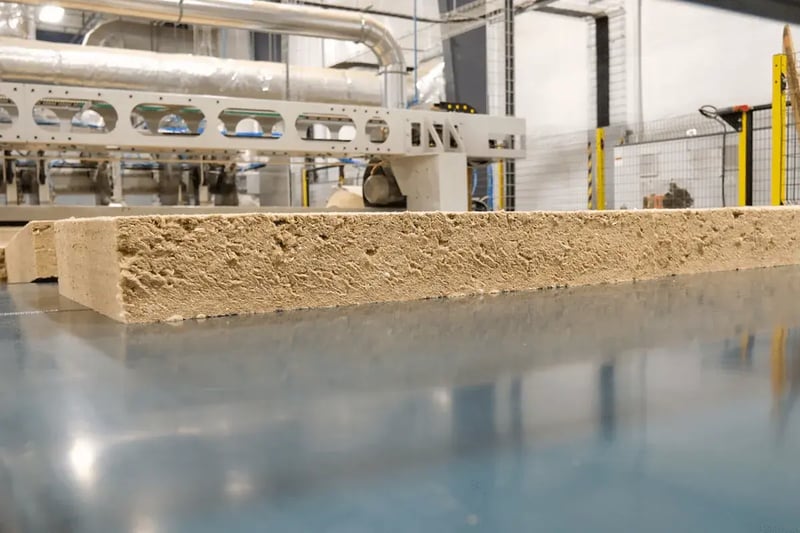
At Green Fox Manufacturing, we tune binder percentages and fiber orientation for specific product densities and compression characteristics. This is what allows the batt to friction‑fit between studs while maintaining loft and R‑value over time. Fire protection is equally important. Pure plant fiber is combustible, so we integrate an environmentally responsible fire‑retardant system during production. Our hemp insulation has achieved a Class A fire rating, which gives specifiers a clear, code‑aligned data point when they compare options.
Throughout the line, we monitor basis weight, thickness, and density using in‑process checks and batch sampling. These metrics are directly tied to thermal resistance and acoustic performance, so holding tight tolerances is critical. Once the mat is thermally bonded, it is calibrated to target thicknesses and precision cut into standard and custom dimensions, ready for packaging.
VERIFIED PERFORMANCE: THERMAL, ACOUSTIC, & FIRE BEHAVIOR
For today’s specifiers, sustainability claims need to be backed by measurable performance. Hemp insulation sits in the same thermal class as many mineral wool products, with typical conductivity values around 0.038–0.042 W/m·K and R‑values on the order of R‑3.7 per inch, according to industrial datasets summarized by HempFabrica.
Where hemp diverges from conventional batts is moisture behavior and embodied carbon. Hemp fiber can buffer moisture and absorb water vapor then release it again without structural damage or major loss of thermal performance. That property supports more stable interior humidity profiles and helps reduce conditions that promote mold growth in wall and roof assemblies.
Acoustically, the open, fibrous structure of our batts provides high sound absorption coefficients in the mid‑ and high‑frequency ranges. In practice, this means quieter interiors in multifamily, hospitality, or mixed‑use projects when hemp batts are specified in party walls and floor‑ceiling assemblies.
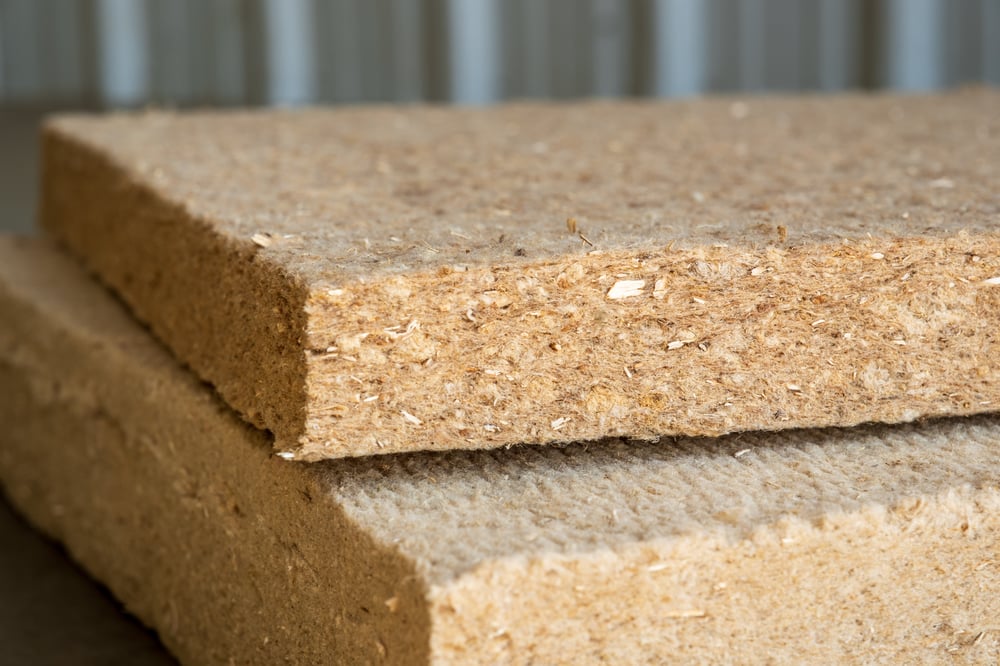
On fire performance, our Class A rating provides a clear benchmark for building officials and fire engineers. Combined with the non‑toxic nature of the fiber and additives, this supports healthier jobsite conditions—installers can handle the product without special PPE, unlike many irritant mineral fibers.
DESIGNED FOR THE JOBSITE
A technical product still has to be practical on site. Our hemp insulation batts are designed for standard wood and light‑gauge steel framing, so crews don’t have to change their basic workflow. Batts are supplied in multiple densities and thicknesses to match common wall, floor, and ceiling assemblies.
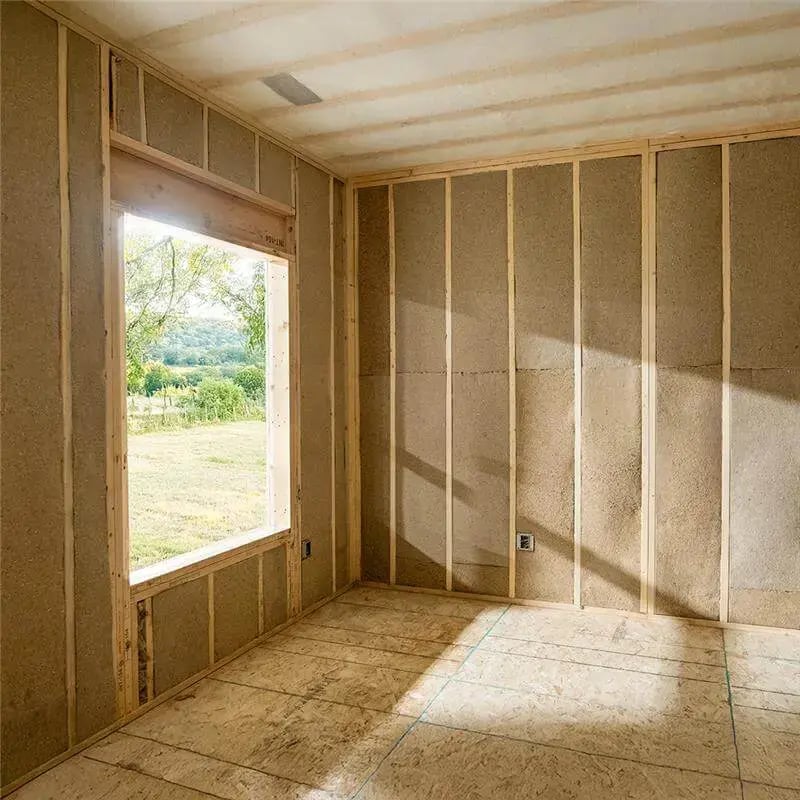
installers friction‑fit the batts between studs or joists; the engineered spring‑back from our nonwoven structure holds them in place without stapling. The batts can be trimmed cleanly with a standard insulation knife or saw to fit around services and irregular framing. Because the material is non‑irritating, crews can work gloveless and without masks in most conditions, which improves productivity and reduces cleanup.
From an application standpoint, we see three primary use cases: interior partitions where acoustic comfort is critical; exterior framed walls where thermal and moisture buffering are key; and roof or attic applications where embodied carbon and long‑term performance drive specification.
HEMP FOR SUSTAINABLE CONSTRUCTION
Across the building industry, sustainable construction is shifting from marketing language to modeled performance. Life‑cycle assessment (LCA) and whole‑building carbon budgets are becoming standard in many jurisdictions and green building programs as the choice of insulation material has a measurable impact on both operational and embodied carbon. Bio‑based options like hemp can significantly reduce global warming potential compared to EPS and rockwool.
At Green Fox Manufacturing, we address this by optimizing our supply chain to minimize transport, waste, and rework. Every part of the hemp plant is used across our Green Fox product families, from grain and oils to insulation batts and acoustic panels, supporting a circular, low‑waste model.
For builders, designers, and owners, that means hemp insulation can contribute to lower operational energy use, improved indoor environmental quality, and reduced embodied carbon. All backed by a transparent, U.S. based manufacturing story you can explain to your clients and project teams.
Custom Nonwoven Manufacturing: What You Need to Know Before Choosing a Partner
Choosing a custom nonwoven man …
Green Fox Manufacturing: A New Partner for Fiber Innovation
Green Fox Manufacturing is a U …
Hemp Hurd to High-Performance: Inside Green Fox Manufacturing
Hemp hurd is the woody core of …